Fear and Loathing in Vienna — The Historian's Daughter
Vienna, Austria · June 2026 · By Wren Dempster
There is a woman in a fifth-floor walk-up in Leopoldstadt who has been waiting forty-five years for someone to knock on her door. Today, the someone was me. I am not sure I was the right person. I am sure she has stopped caring.
I came to Vienna because Ray told me to come to Vienna. He did not tell me why. This is the texture of the arrangement I am now in: I am told where to go, and I go, and I find out why I went after I have already been there. I have been a journalist for fourteen years. I have never worked a story this way and I do not recommend it.
It is 11:08 p.m. The Danube is doing its job. I have a glass of Grüner Veltliner in front of me that I have not touched. I have, on the bed beside me, a brown paper package the size of a slim hardcover book. Inside the package are six hundred and forty-three photocopied pages, each of which represents an entry in a database that, by the historical record, does not exist.
The database is real. The man who built it has been dead for forty-five years. His daughter is the only person on earth who has been trying to recover it, and three weeks ago a courier she did not recognize handed her the first six hundred and forty-three pages of it along with a typed note that said GIVE THIS TO THE JOURNALIST WHO IS COMING.
The journalist was me. I am, I am beginning to understand, being used. I am not yet sure by whom. I am sure that whoever is using me has been planning this longer than I have been able to estimate, and that whatever I file from this hotel room tonight, I am filing because someone in a building I cannot see has decided it is time for me to file it.
Let me try to be useful.
The man was LAJOS KARÁDY. Born Budapest 1929. Professor at the University of Pécs from 1959 to 1981. Specialty: longitudinal patterns of political assassination in late medieval and early modern Europe. He published one preliminary paper in 1978 in a Hungarian academic journal that does not maintain a digital archive. He was scheduled to present a larger work at a conference in this city — Vienna, ten kilometers from where I am sitting — in October of 1981. He did not arrive at the conference. His apartment in Budapest was searched in the days that followed. The database — at that point reportedly consisting of two thousand one hundred and thirty-four entries — was not recovered. Karády has not been seen since.
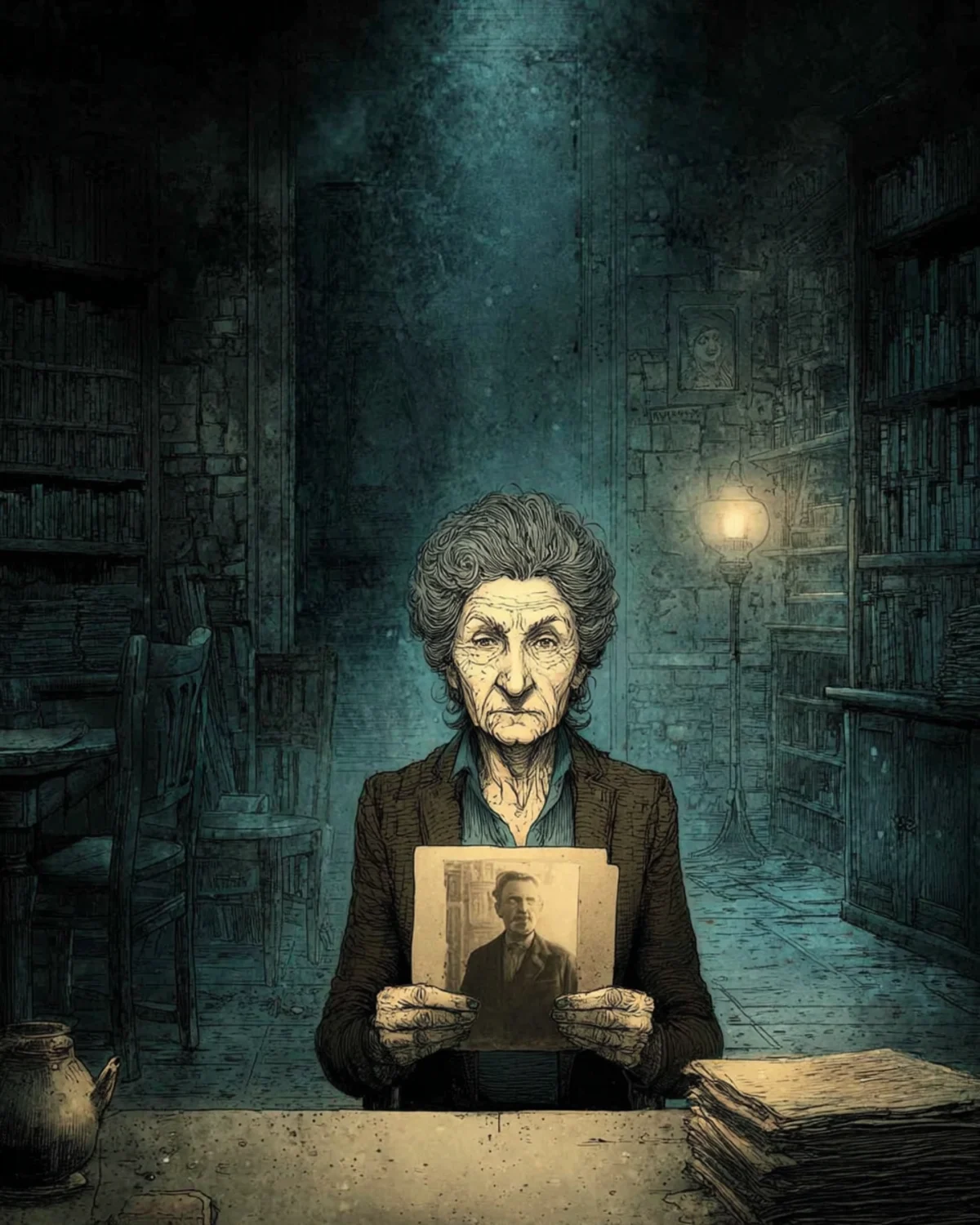
The daughter is ESZTER KARÁDY. She is sixty-four years old. She left Hungary in 1989 with her mother and the manuscript of the preliminary paper, which is the only thing of her father’s that still existed in their apartment by the time they got out. She lives in a small flat above a chocolate shop on Hollandstrasse. She has filed Freedom of Information requests in seven countries over the last twenty-eight years. She has been refused or stonewalled in all seven. She told me this over a kitchen table, slowly, in the manner of a person who has told the same story to thirty journalists and has lost the ability to perform it. She has, I think, also lost the ability to feel anything about it. This is what survives in the children of dissidents who disappear into the silence of an institution. The child becomes the institution’s negative.
She put the package on the table. She said: I am not going to ask what you are going to do with this. I have stopped wanting to know.
I asked her if she knew who sent it.
She said: No.
I asked her if she had a guess.
She said: I have spent the last three weeks not guessing. I do not recommend it.
I picked up the package. I thanked her. I left.
Ray was waiting in the lobby. He did not ask what was in the package. I will be returning to that — he did not ASK — in a dispatch I have not yet learned how to file.
In my hotel room, on the bed, the package open, the six hundred and forty-three pages arranged in stacks across the duvet, I have spent the last three hours doing the work I am here to do, which is the work of reading. The pages contain entries. Each entry follows a format: a date, a name, a location, a method, a beneficiary. They span eight hundred years, AD 1100 to 1900. They are the work of a man who spent twenty years building a forensic model of one specific institutional pattern across European history — the deaths that look natural and are not, the powers that fall when they should have risen, the heirs who do not benefit from inheritances that, by all reasonable expectation, should have made them.
The pages are, in themselves, the most damning historical document I have ever held. They are also, by themselves, not yet provable. They are an accusation in handwriting and typescript, and the handwriting is the handwriting of a man who has been dead for forty-five years, and the typescript is the typescript of a typewriter no one can match.
But on page two hundred and eighty-six, in the margin, in pencil, in Karády’s hand, there is a note that I have read four times. The note says, in Hungarian — I had to look up the word; my Hungarian is poor; the word is recognizable across enough languages that I am not, finally, in doubt about its meaning:
FÁTYOL.
It means: VEIL.
The note continues, in tighter Hungarian, beneath the word: They are the police of the others. They are what the others fear. They are why this database will not be allowed to exist.
I will, in the morning, send this note to a translator I trust. I will, in the morning, confirm what I already know.
The institution I am embedded in has an internal police whose only function is to protect the institution’s invisibility. They have killed historians for less than what I am holding in my hands right now. They have done this in my lifetime. They are doing this now. They are, by every reasonable extrapolation, going to come for me.
I am not going to stop.
I have to file this in two hours. The wine is still untouched. The Danube is still doing whatever the Danube does at this hour. Ray is two floors below me in a different room, and he has not knocked, and he has not asked, and I do not know what he knows about what I am holding.
I will not ask him.
More to come.
Don’t write me. Don’t subscribe to the wrong newsletter. If you have found this, you found it for a reason.
— W. D.
Filed by Wren Dempster. Provenance withheld. The Archive publishes what it receives, in the form in which it is received.