You have found a book.
THE BLACK CIRCLE is a novel, published here one chapter at a time as it is written. It is planned as a trilogy. You can read it in order, free, as it goes.
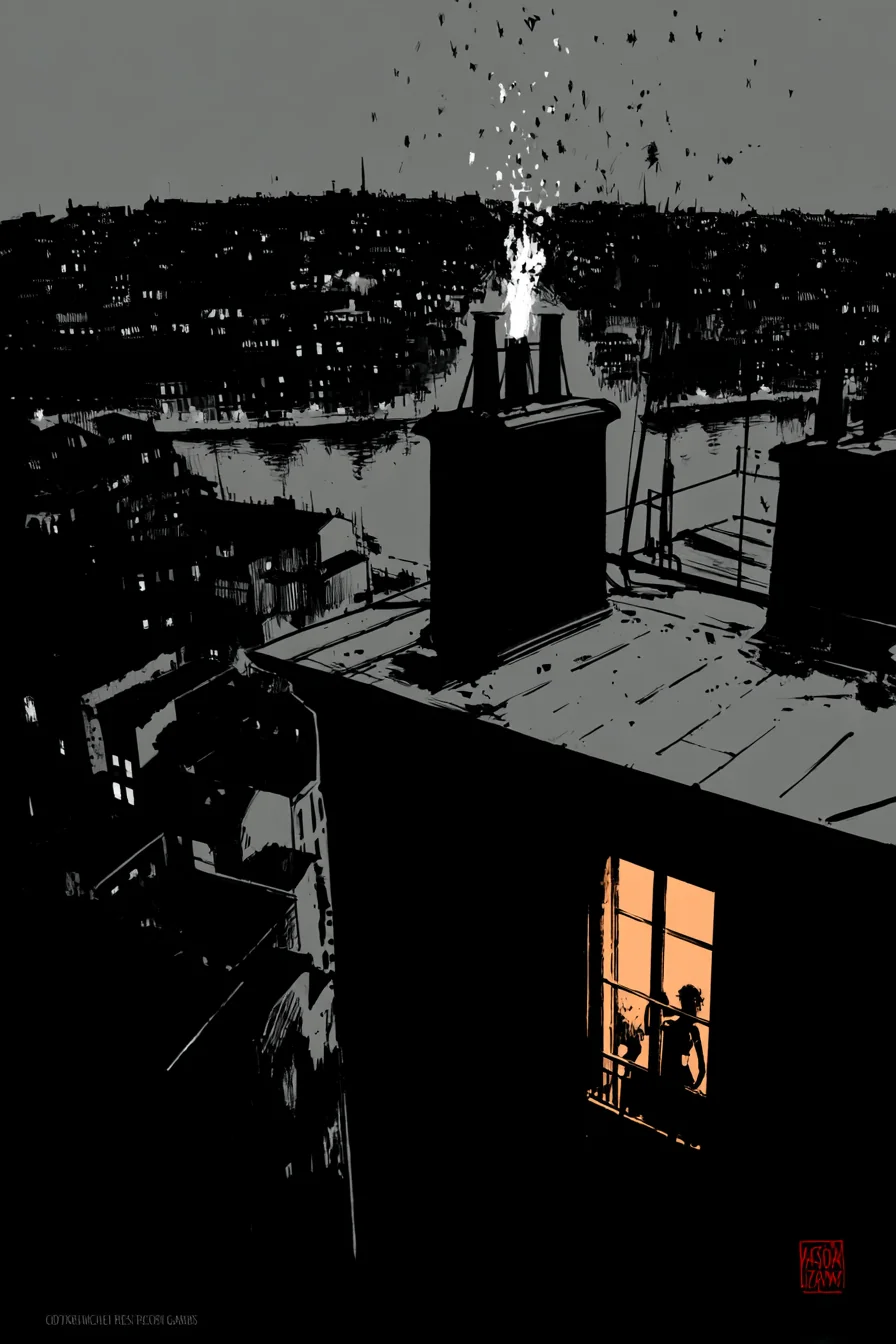
It is built a little differently than most novels. The artwork across these pages is part of the book, not decoration around it — it is woven through the chapters, in the visual register each scene calls for. The score is part of it too. The Archive collects the people, places, and records the story refers to. All of it serves the novel; the novel is the thing.
THE PREMISE
A journalist named Wren Dempster has spent eleven years writing about power, and the last few of them learning that power leaves no evidence. She is in Lisbon, working a story she does not care about, when a package comes under her door at four-eleven in the morning.
Inside is a single photograph. It is forty-five years old. It documents a killing in a Belgrade hospital in 1981, and the man holding the weapon — young then, distinguished now — is on the cover of last week's Economist.
Someone has sent her proof of a thing that is not supposed to be provable. Someone has been watching her long enough to know she is the one person who would recognize it. And someone, she will discover, has sent the same kind of package to a handful of other people across Europe, none of whom know the others exist.
The institution the photograph implicates calls itself the Circle. It has existed, in some form, for twenty-three centuries. It has never been photographed, never been named in print, and never lost a member to an outside force. It is about to be photographed. What the Circle is, and what it costs to expose it, is the question the trilogy answers.
THE TRILOGY
Book One — The Package
The book you are beginning. Wren receives the first package and follows it out of Lisbon and across a continent. She finds the others who have been chosen: a woman in Vienna whose father vanished in 1981; a dying publisher in London who recognizes handwriting on an envelope from a man he buried in 2019. She builds a wall of evidence, and the wall fills faster than she can keep up with.
Then the Circle responds. The recipients begin to die — quietly, plausibly, in ways the coroners do not question. Wren goes underground. She abandons her name, her devices, her career, and disappears into the south of France to read what she has gathered and write a book she knows will get her killed.
And then she meets the man who has been sending the packages. His name is Ray Thorne. His father has been dead for seven years. The handwriting on the envelopes is his father's, and it is recent. Book One ends in the basement of an English country house, in front of a vault that holds seven generations of the Circle's secrets, with Wren's hand on a sealed envelope no one has been willing to open.
Book Two — The Pruning
The Circle stops being patient. The institution that has spent twenty-three centuries managing the world from outside it turns that management on the handful of people who have seen too much. Recipients fall. Allies fracture. Wren and Ray go from investigating the Circle to running from it, and the running takes them into the deep history of the thing they are trying to expose — the factions that have shaped it, the rituals that sustain it, and a name out of the Circle's own mythology that no one was supposed to speak.
Inside the Circle, the Chair of the Council discovers that the leak is not coming from outside at all. Someone at his own table has been bleeding the institution's secrets for years. The hunt for Wren becomes, in parallel, a hunt for a traitor in a room of seven people who have known one another for decades.
Book Three — The Seventh Law
The endgame. Everything the first two books have been circling resolves into the question of what the Circle actually is, beneath the politics and the killing and the centuries of careful management. The answer is not what the surface suggested.
There is a law at the center of the Circle that has never been written down. There is a figure the institution has spent two thousand years removing whenever it appears. By the end of Book Three you will know both — and you may not be sure, when you close the book, whether what Wren does is a victory or a tragedy.
THE WORLD
THE BLACK CIRCLE spans twenty-three centuries. The present-day investigation in 2026 is the spine, but the trilogy moves back through the institution's history in chapters that stand on their own: a killing in Belgrade in 1981; a founding in a Macedonian wine merchant's stall in 309 BC; the recovered testimonies of people the Circle has erased across the centuries between.
The settings are real and specific — Lisbon at four in the morning, a Vienna apartment, a Bloomsbury publishing house, a Belgrade hospital the state would prefer forgotten, an English country house with a vault beneath it.
HOW TO BEGIN
- Read Chapter One — The Package.
- Subscribe, and each new chapter reaches you the morning it is filed.
- Explore the Archive — the people, the places, the factions, the records.
Filed by Wren Dempster. Provenance withheld. The compilation continues.